Lane-Level Freeway Traffic Anomaly Detection
A graph-based generative adversarial model for early detection and localization of anomalous traffic events across freeway lanes, while minimizing false alarms.
The problem
Detecting freeway incidents at an early stage remains challenging, particularly when disruptions initially affect only a small portion of the roadway. Conventional monitoring systems often rely on surveillance cameras, manual observation, and incident reports, which can introduce delays in identifying emerging disruptions.
High-resolution radar networks provide detailed traffic measurements across individual lanes, creating opportunities for more precise incident detection. However, identifying abnormal conditions requires models that can capture spatial dependencies between neighboring lanes and road segments while distinguishing unexpected disruptions from normal traffic variations.
Data
Interstate 24 · Nashville, Tennessee
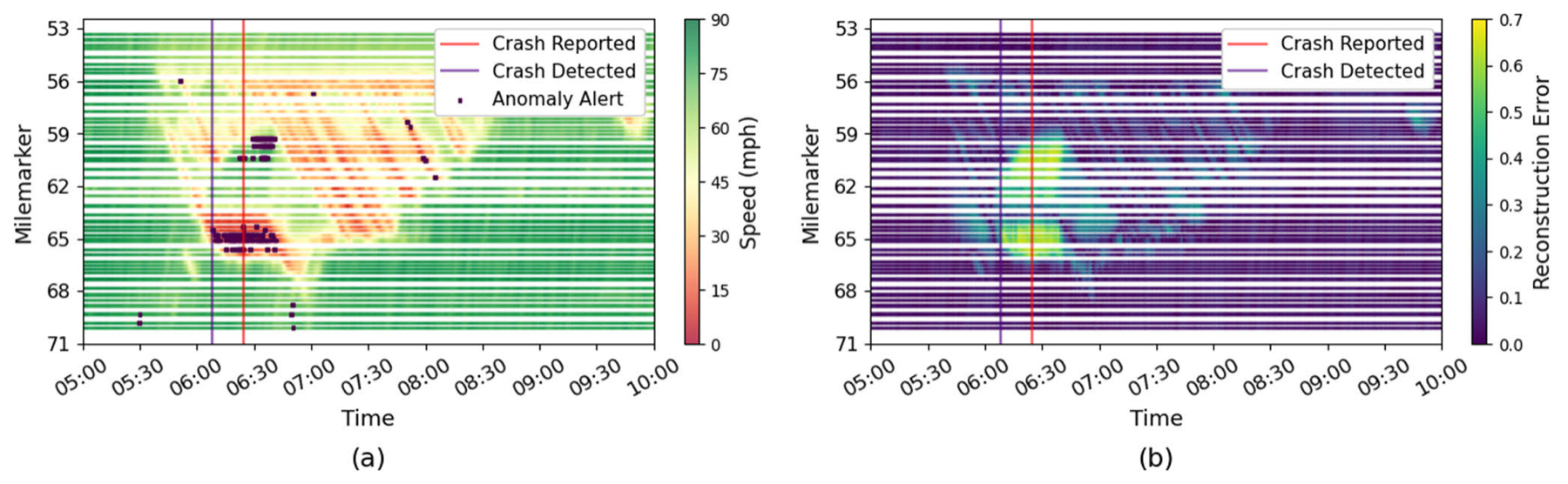
The measurements come from the FT-AED (Freeway Traffic Anomalous Event Detection) dataset: speed, occupancy, and traffic volume for each lane, recorded in October 2023, with labeled crash events. The labeled crashes were used only for evaluation.
Approach
Graph-based traffic representation
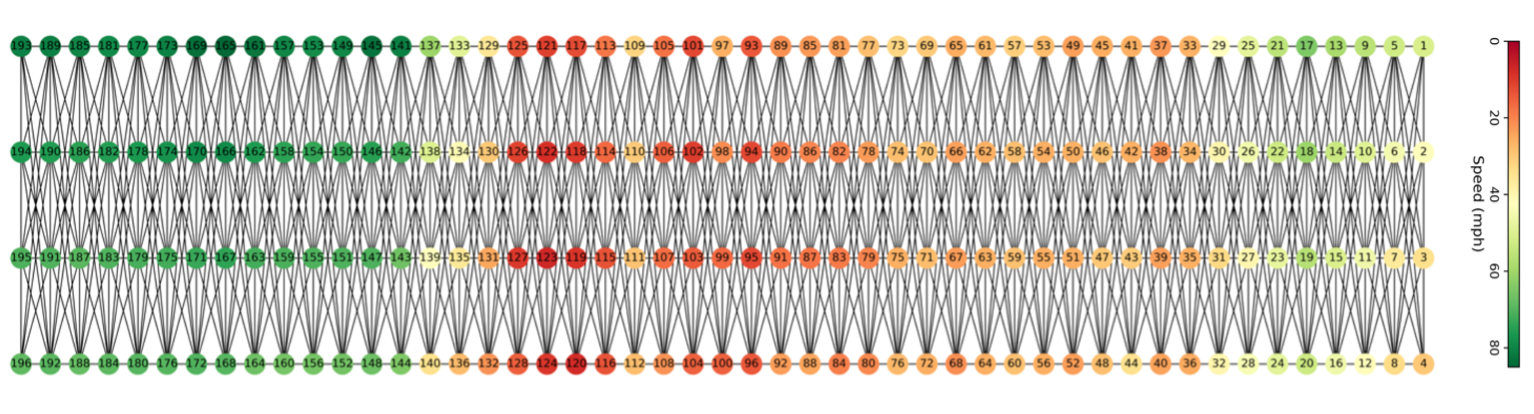
Freeway traffic is represented as a graph in which each node corresponds to a specific lane at a given mile marker. Nodes are connected to neighboring lanes at the same location and to lanes at adjacent mile markers.
This structure allows the model to capture spatial dependencies across the freeway network rather than treating individual sensor measurements independently.
CCB-GraphGAN architecture
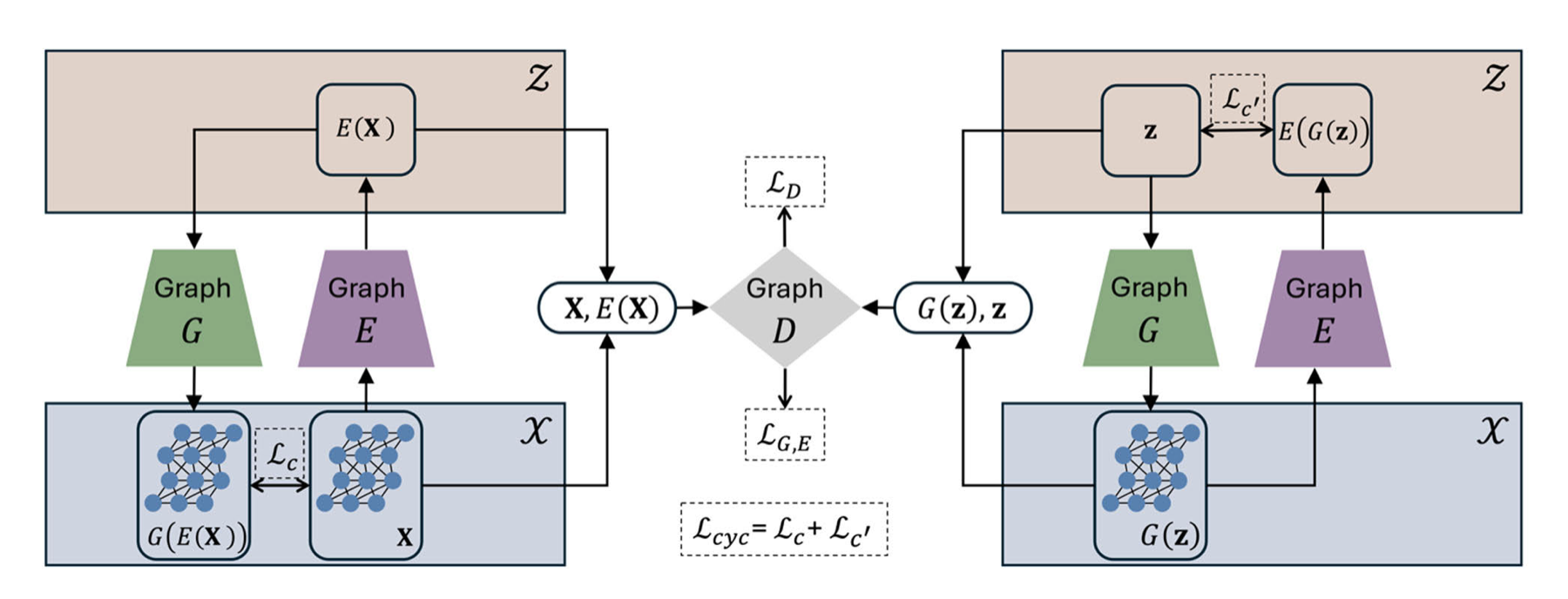
CCB-GraphGAN (Cycle-Consistent Bidirectional Graph Generative Adversarial Network) is proposed as an extension of the Bidirectional GAN framework for anomaly detection in graph-structured traffic data.
The architecture consists of three components, all implemented using Graph Attention Network (GAT) layers:
- Generator: maps latent representations into synthetic traffic feature matrices, learning to reproduce the distribution of normal traffic conditions.
- Encoder: maps observed traffic data into a compact latent representation, learning the inverse mapping of the generator.
- Discriminator: distinguishes between real traffic–latent representation pairs and generated pairs through adversarial training.
Cycle-consistency learning
A key component of the proposed architecture is the introduction of two auxiliary cycle-consistency losses in the data and latent spaces. These constraints encourage the generator and encoder to learn consistent inverse mappings:
- Data-space consistency: reconstructs the original traffic features after encoding and generation.
- Latent-space consistency: recovers the original latent representation after generation and re-encoding.
Together, these constraints improve reconstruction fidelity and provide a more reliable basis for identifying deviations from normal traffic behavior.
Lane-level anomaly detection
During training, the model learns exclusively from normal traffic observations. During inference, the encoder and generator reconstruct each observed traffic state.
Anomalies are identified through reconstruction errors computed independently for each graph node. When a node’s reconstruction error exceeds its location-specific detection threshold, the corresponding lane is flagged as anomalous.
This enables the model to identify not only when abnormal traffic conditions emerge, but also where they occur across the freeway network.
Results
Comparative evaluation
Compared with all evaluated baseline models, CCB-GraphGAN:
- detected anomalies earlier;
- missed fewer crashes at both 1% and 5% false positive rates;
- achieved a higher area under the ROC curve (AUC);
- reconstructed normal traffic more accurately.
Methods & tools
Graph attention networks · bidirectional GANs · cycle-consistency learning · anomaly detection · Python · PyTorch
This research was supported by the U.S. National Science Foundation under Grant No. CMMI-2026795.